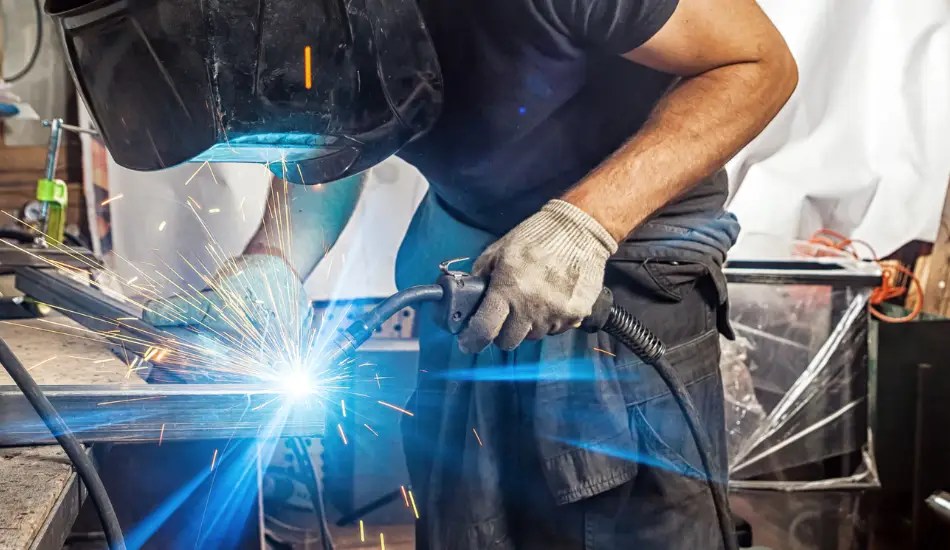
Fiber laser welding lays down a narrower, cleaner weld with a fraction of the heat input of stick welding, so thin and mid-gauge metal comes off the bench nearly finish-ready with little to no grinding. Stick welding, also called SMAW, still wins on thick, rusty or painted material and on outdoor jobs where a laser’s clean-metal requirement and line-of-sight setup are not practical. Neither process replaces the other across the board, and most repair shops that add a handheld fiber laser welder keep their stick machines running for a different slice of the work.
What Is the Real Difference Between Fiber Laser Welding and Stick Welding?
Stick welding strikes an arc between a flux-coated electrode and the base metal, melting both to form the joint while the flux burns off as a gas shield and leaves slag on top that has to be chipped away. Fiber laser welding instead focuses a beam of concentrated light through a handheld torch onto the joint, melting a narrow line of metal with a heat-affected zone measured in millimeters rather than the wide scorch mark stick welding leaves.
That heat-affected zone is the whole story. A tighter zone means less warping, less discoloration, and a weld that often needs only a light wipe instead of a grinder. It also means the laser has to see clean, bare metal to do its job, where a stick electrode’s flux will burn straight through mill scale, light rust, and old paint without complaint.
Which Process Welds Faster on Thin Metal?
Fiber laser welding is faster on anything from about 24 gauge up through roughly 1/8 inch, which covers most sheet metal, trailer skin, exhaust tubing and HVAC duct repair. A handheld 1500W to 2000W unit runs a continuous bead at walking pace without the stop-start rhythm of striking a new stick electrode every few inches, and it does it without blowing through the material the way an amperage-heavy stick pass will on anything under 1/8 inch.
Stick welding on that same thin material takes a slower hand and more amperage control, and even a careful welder will fight burn-through and warping on 16 gauge and thinner. Shops running thin sheet metal jobs, like the trailer skin and exhaust repair work we have covered before, generally reach for the laser first for exactly this reason.
Which One Handles Thick or Rusty Material Better?
Stick welding still wins on thick structural steel, rusty equipment, and anything welded outdoors in wind. SMAW punches through mill scale, surface rust and paint that would stop a laser cold, and it does not care about a breeze the way a shielding-gas process does. On 3/16 inch and thicker steel, especially equipment that has been sitting outside, stick is usually the faster, more forgiving choice.
A handheld fiber laser welder needs bare, clean metal and a controlled setup to lay a good bead, and most handheld units are built for sheet metal and mid-gauge work rather than heavy structural sections. Pushing a laser past its practical thickness range means multiple passes and filler wire, which erases the speed advantage that makes it worth owning in the first place.
How Much Cleanup and Rework Does Each Process Need?
Stick welding leaves slag that has to be chipped and wire-brushed off every pass, plus spatter that needs grinding before paint or a finish coat goes on. On thin material it also leaves enough heat distortion that a shop often has to plan extra time for straightening the piece before it is usable.
Fiber laser welding produces almost no spatter and no slag at all, so the weld is close to paint-ready as it comes off the torch. The narrow heat-affected zone means visible parts, like a trailer fender or an exhaust flange, rarely need the grinding and straightening that a stick weld on the same part would require.
What Does Each Process Cost a Repair Shop to Run?
Stick welding wins on upfront cost and running cost: a capable stick machine can be bought for a few hundred dollars and electrodes cost pennies each, though labor time for cleanup adds back into the real per-job cost. A handheld fiber laser welder is the bigger upfront investment, but it cuts labor hours on cleanup and rework, uses lower-cost shielding gas instead of consumable electrodes, and pulls less total power per finished weld because there is no re-striking or reheating a joint that warped.
| Factor | Stick Welding (SMAW) | Fiber Laser Welding |
|---|---|---|
| Best material thickness | 3/16 inch and up | 24 gauge to about 1/8 inch |
| Surface prep needed | Tolerates rust, mill scale, paint | Requires clean, bare metal |
| Outdoor / windy conditions | Works fine | Shielding gas is wind-sensitive |
| Post-weld cleanup | Slag chipping, grinding, spatter removal | Little to none, near finish-ready |
| Heat distortion on thin metal | High | Low |
| Upfront equipment cost | Lower | Higher |
| Learning curve | Moderate, years to master overhead and vertical positions | Shorter for straight seams once torch handling is learned |
Which Should a Repair Shop Actually Choose?
Shops doing heavy equipment, structural steel, or anything rusty and outdoors should keep stick welding as the primary process, since that is the work it is built for. Shops taking in trailer bodies, exhaust systems, HVAC duct, auto body panels, and general sheet metal repair get more value from adding a handheld fiber laser welder alongside the stick machine than from replacing it outright.
The shops we work with who run both processes typically route a job by material thickness and finish requirement at intake, not by which machine is already warmed up. That single habit change is usually what determines whether the laser investment pays for itself in the first year.
FAQ: Fiber Laser Welding vs. Stick Welding
Can a fiber laser welder replace a stick welder completely?
No. A handheld fiber laser welder is built for thin to mid-gauge clean metal, while stick welding still covers thick, rusty, painted or outdoor work that a laser cannot handle. Most shops run both rather than replacing one with the other.
Is a fiber laser weld stronger than a stick weld?
On thin metal, yes, because the narrower heat-affected zone leaves more of the base material’s original strength intact instead of weakening a wide band around the joint. On thick structural steel where stick welding is the right process to begin with, a properly run stick weld is fully strong for the application.
How much training does a handheld fiber laser welder take compared to a stick welder?
Stick welding takes years of experience to master overhead and vertical positions cleanly, while a handheld fiber laser welder has a shorter learning curve for straight, flat seams once an operator is comfortable with the torch and travel speed. Neither process is instant, and both reward a shop that trains its welders on the machine before putting it on paying work.
Does fiber laser welding need special ventilation or safety gear?
Yes. A handheld fiber laser welder requires laser safety glasses rated for the specific wavelength and a properly ventilated or enclosed work area, which is different personal protective equipment than a standard welding hood and gloves used for stick welding. See our fiber laser welding safety guidelines before putting a unit into daily use.
For a closer look at where each process fits in a working shop, see our guides on fiber laser welding for trailer and RV repair and fiber laser welding automotive exhaust systems, or compare current models on our handheld fiber laser welder product line and pricing page. The American Welding Society’s welding process overview is a good independent reference for how SMAW and laser welding are classified.
Ready to see which process fits your shop’s mix of work? Get a free quote or call us at (615) 333-7284 to talk through your material thickness and finish requirements with our team.