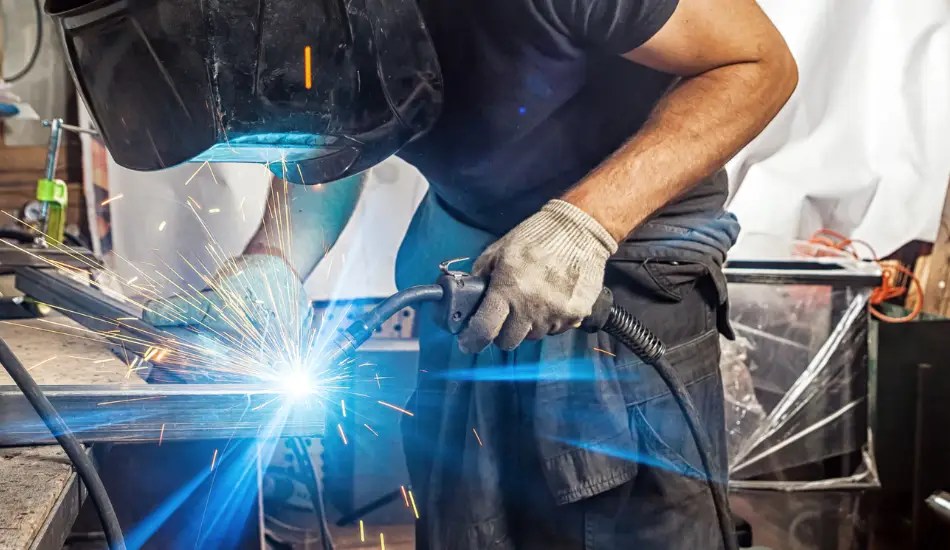
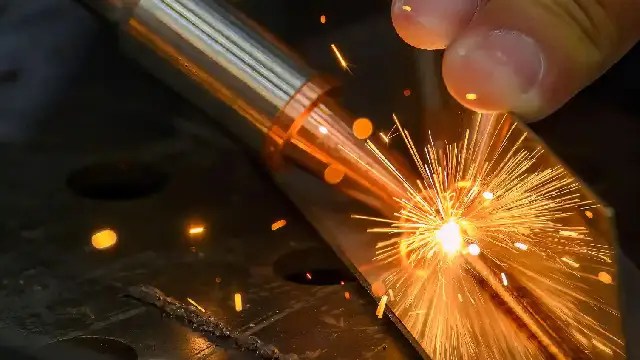
A handheld fiber laser welder from Fiber Laser Welding handles mild steel and stainless steel from 0.5mm up to about 6mm to 8mm in a single pass, depending on wattage, and thicker material with multiple passes or a wider weld pattern. A 1500W unit is built for gauge metal and general fabrication up to roughly 4mm to 5mm, while a 2000W unit extends comfortably into 6mm to 8mm steel, which covers most sheet metal, HVAC, automotive and light structural work a fabrication shop takes on.
Thickness capacity is the single most common question a shop asks before buying a handheld fiber laser welder, because it decides whether the machine replaces a MIG welder for a given job or only supplements it. The short answer is that wattage, not the welder’s design, sets the ceiling, and matching wattage to your actual job mix matters more than buying the highest number available.
How thick can a 1500W handheld fiber laser welder weld?
A 1500W handheld fiber laser welder comfortably welds mild steel and stainless steel up to 3mm to 4mm in a single pass, and can push to about 5mm with a slower travel speed and proper joint preparation. This wattage class fits shops working primarily in sheet metal, cabinetry, HVAC ductwork, enclosures and light fabrication where most material falls under 1/8 inch (roughly 3mm). It is not the right choice for structural steel or heavier equipment fabrication where plate thickness regularly exceeds 5mm.
How thick can a 2000W handheld fiber laser welder weld?
A 2000W handheld fiber laser welder extends single-pass capacity to roughly 6mm on mild steel and slightly less on stainless steel and aluminum, which have different thermal conductivity and reflectivity. Shops that regularly weld structural brackets, heavier gauge enclosures, trailer components or equipment frames in the 5mm to 8mm range are better served by the higher wattage unit, since attempting that thickness on a 1500W machine means multiple passes, longer cycle times and a higher chance of incomplete fusion at the root.
| Material and thickness | 1500W handheld | 2000W handheld |
|---|---|---|
| Mild steel, 1mm to 3mm | Single pass, full speed | Single pass, full speed |
| Mild steel, 4mm to 6mm | Slow travel, possible second pass | Single pass at moderate speed |
| Mild steel, 6mm to 8mm | Not recommended | Single pass, reduced travel speed |
| Stainless steel, 1mm to 3mm | Single pass, full speed | Single pass, full speed |
| Aluminum, 1mm to 2mm | Single pass with correct shielding gas | Single pass with correct shielding gas |
Why does material thickness capacity differ by metal type at the same wattage?
Aluminum and stainless steel reflect more of the laser’s energy than mild steel does and conduct heat away from the weld pool faster, so both materials weld to a lower maximum thickness at a given wattage than mild steel does. A 2000W unit that welds 6mm mild steel cleanly may only handle 3mm to 4mm aluminum reliably, which is why a shop that works primarily in aluminum, such as trailer builders or marine fabricators, should size the machine to their aluminum jobs specifically rather than to the mild steel number on a spec sheet.
What happens if you try to weld metal thicker than the machine’s rated capacity?
Pushing a handheld fiber laser welder past its practical thickness ceiling produces incomplete penetration, meaning the weld looks fused on the surface but has not fully joined the material beneath it, which is a structural failure point under load. Operators sometimes try to compensate with a slower travel speed or repeated passes over the same seam, and while that can extend capacity by a millimeter or two, it also increases heat input into the surrounding metal, which raises the risk of warping on thinner adjacent sections. When a job regularly exceeds the machine’s rated thickness, the correct fix is either a higher wattage unit or a hybrid approach that uses MIG or TIG for the thick sections and the fiber laser welder for the fast, low-distortion sections.
Frequently asked questions
Can a handheld fiber laser welder weld through rust or mill scale on thicker steel?
Not reliably. Fiber laser welding depends on a clean, consistent surface to couple energy into the joint efficiently, and rust, mill scale or paint on thicker material causes inconsistent penetration and visible porosity. Surface prep with a grinder or wire wheel before welding matters more on a fiber laser welder than it does on a MIG welder, which tolerates a dirtier surface somewhat better.
Does joint type change the maximum thickness a fiber laser welder can handle?
Yes. A butt joint on flat material welds thicker than a lap joint or a fillet weld at the same wattage, because a butt joint concentrates the beam directly into the seam rather than across an overlap. Shops working mostly in fillet and lap joints, common in enclosure and bracket fabrication, should plan for roughly 1mm less capacity than the flat butt joint numbers a spec sheet quotes.
Is a handheld fiber laser welder a replacement for a MIG welder on thick material?
No, and it is not meant to be. Fiber laser welders excel at speed, low heat input and clean cosmetic welds on gauge metal and mid-thickness steel, while MIG and stick welding remain the better tools for heavy plate, structural steel and thick-wall pipe. Most fabrication shops that add a fiber laser welder keep their MIG and TIG equipment for the jobs above the laser’s practical range.
Fiber Laser Welding, part of Fab-Line Machinery, sells and services handheld fiber laser welders out of Brooklyn Park, Minnesota, and ships to fabrication shops across the Twin Cities and nationally. With years of experience matching wattage to real job mixes rather than spec-sheet maximums, our team walks new buyers through actual job samples before recommending a machine. See the full product lineup and current pricing, or request a free quote at (615) 333-7284 and bring in a sample of your typical material so we can confirm the right machine for your shop.