

Medical device shops do not get a second chance on a weld. A surgical instrument, a catheter component, an implant housing, or a diagnostic cartridge body has to pass a visual inspection, a pressure test, and often a biocompatibility review before it ever reaches a patient. A weld that is strong but ugly, or one that leaves heat-affected discoloration inside a sealed enclosure, can fail that review even when the part itself is sound. That is the gap a handheld fiber laser welder closes for contract manufacturers and small device shops that cannot justify a fixed automated welding cell for every new part number.
Why TIG and resistance welding struggle on medical parts
TIG welding works on medical-grade stainless and titanium, but the heat-affected zone runs wide, and thin-wall tubing (0.015 to 0.035 inch, common on surgical instruments and endoscopic components) warps or burns through before the arc fully fuses the joint. Resistance welding handles some sealed enclosures but leaves a visible nugget and limits joint geometry to lap and spot configurations, which rules out the butt and corner joints common on instrument housings.
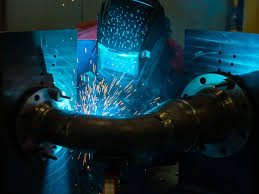
A handheld fiber laser welder runs a narrower, more controllable heat-affected zone than TIG, typically a fraction of a millimeter on thin sections, which is why it has become the second machine (after a fixed laser welding cell) that device-adjacent fab shops add when they start taking on medical work. The seam comes out smooth enough on 316L and 304 stainless, and on grade 2 and grade 5 titanium, that many parts need little to no secondary polishing before passing inspection.
What parts actually get welded this way
The work that comes through a fab shop for medical device clients is rarely glamorous. It is housings, brackets, and instrument bodies, not implants themselves (implant welding is almost always done on dedicated, validated automated cells under a device maker’s own quality system). The handheld laser welder’s role is the surrounding hardware:
- Stainless steel surgical tray and cart frames, where a clean cosmetic seam matters as much as strength
- Diagnostic equipment enclosures and chassis, often 304 or 316L sheet, where a sealed, leak-tight joint is required
- Titanium and stainless instrument handles and housings for reusable surgical tools
- Mounting brackets and carts for imaging and lab equipment, where repeatability across a production run matters more than any single weld
None of this replaces a device OEM’s own validated manufacturing line. It is the supporting fabrication that a contract shop does around that line, built to the OEM’s print and inspected against their tolerance, not welded under the OEM’s own quality system.
Settings that hold up on 316L stainless and titanium
316L stainless in the 0.02 to 0.06 inch range typically runs 400 to 700 watts on a handheld fiber laser welder, matching the wattage-to-thickness guidelines for thin material, pulse or continuous mode depending on the joint, with argon shielding at 15 to 20 CFH to prevent oxidation discoloration on the cosmetic face. Titanium needs tighter shielding discipline: argon coverage has to extend past the weld pool as it cools, usually through a trailing shield cup, because titanium picks up oxygen and nitrogen contamination (visible as a blue or gray heat-tint) at temperatures well below its melting point. A contaminated titanium weld is a cosmetic and a mechanical problem, since the embrittlement that comes with it is exactly what a device inspection is designed to catch.
Wire feed matters more on medical work than on general fabrication because gap-fill tolerance is tighter: a press-fit housing seam has little room for a filler bead that proud of the surface, so operators often run thinner filler wire at a slower feed than they would on a heavier fabrication job, trading speed for a flush cosmetic finish.
Why this matters for a small fab shop’s bid
A device OEM or a Tier 2 medical contract manufacturer qualifying a new supplier asks about repeatability before they ask about price. A shop running a handheld fiber laser welder can show a tighter, more consistent heat-affected zone across a production run than one running TIG, because the laser’s energy delivery does not drift with operator fatigue the way a manual arc does over an eight-hour shift. That consistency is what gets a shop past a supplier qualification audit, and it is usually a stronger argument than the per-part cycle time improvement, since medical buyers care first about parts that look and measure the same on unit 1 and unit 500. Industry welding equipment suppliers have documented the same shift toward laser processes across device manufacturing broadly, citing precision and repeatability as the primary driver, in line with what shows up on a fab shop floor (Amada Weld Tech, Top 4 Uses of Lasers in Medical Device Manufacturing).
Documentation and traceability a device buyer will ask for
A device OEM or contract manufacturer qualifying a new welding supplier is not just buying a weld, they are buying a paper trail. Expect a request for a documented welding procedure specification (even if informal, for non-aerospace/non-pressure-vessel medical hardware there is often no mandatory code, but the buyer still wants it written down), lot traceability on wire filler material and shielding gas, and a record of settings per part number so a repeat order in six months runs the same parameters as the first. Shops that keep this documentation as a matter of course, rather than producing it only when asked, qualify faster and get asked for fewer samples before an order goes to production volume.
Cosmetic inspection criteria are usually spelled out by the buyer’s print: acceptable heat-tint range, surface finish requirements, and whether any visible porosity is allowed at all. Photograph a sample weld against the buyer’s own accept/reject criteria before quoting a job at volume, since a setting that passes on a prototype part does not always hold once wall thickness or fixturing changes on the production run.
FAQ
Can a handheld fiber laser welder weld surgical implants?
Implants themselves are almost always welded on dedicated, validated automated equipment under the device maker’s own quality system, not on a handheld unit at a contract fab shop. Handheld fiber laser welding is the right tool for the supporting hardware around that line: housings, instrument bodies, trays, and brackets, not the implant itself.
What shielding gas setup prevents titanium contamination?
Argon shielding that covers the weld pool through the full cool-down, not just during the arc, usually delivered through a trailing shield cup rather than a standard nozzle. Titanium absorbs oxygen and nitrogen at temperatures below its melting point, and any gap in coverage during cooling shows up as blue or gray heat-tint discoloration, a sign of embrittlement that will fail inspection.
Does fiber laser welding eliminate the need for polishing on stainless medical parts?
Often, yes, on thin-gauge 316L and 304 stainless the seam comes out smooth enough to skip a secondary polish step, which is one of the bigger time savings over TIG. It depends on the specific cosmetic spec the device OEM requires; some surgical tray and housing specs still call for a light polish pass regardless of weld quality.
What wattage is typical for medical device fabrication work?
Most of the thin stainless and titanium work in this space runs 400 to 700 watts. Heavier brackets and cart frames in thicker stainless can run higher; the part thickness and joint type, not the material alone, determine the right wattage.
Fiber Laser Welding supplies handheld fiber laser welders built for exactly this kind of precision fabrication work, with wattage options and wire feed configurations suited to thin stainless and titanium. Get a free quote to find the right machine for your shop’s part mix.


