
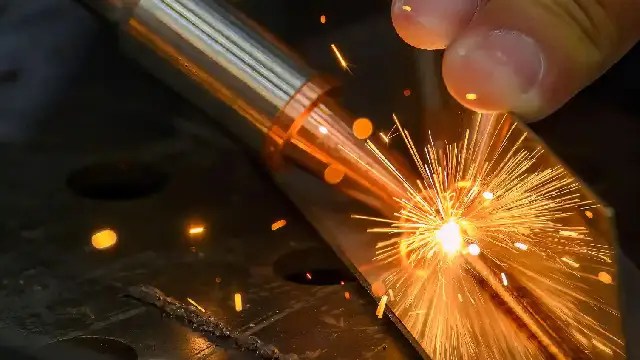

Fiber laser welding aluminum works well once the settings account for the metal’s high reflectivity and thermal conductivity, but it punishes guesswork more than steel does. Get the power, speed and shielding gas wrong and you get porosity, blowthrough or a weld that looks clean on top and is weak underneath. Get it right and a handheld fiber laser welder produces a fast, low-distortion aluminum weld that would take a skilled TIG welder several times as long.
Why is aluminum harder to fiber laser weld than steel?
Aluminum reflects a significant portion of the laser’s energy instead of absorbing it, especially at the start of a weld before the surface heats up, which means the machine needs more power to establish a stable weld pool than the same joint in steel would need. Aluminum also conducts heat away from the weld zone roughly three times faster than steel, so that energy has to be sustained rather than pulsed the way you might weld thinner steel. On top of that, aluminum forms an oxide layer within seconds of exposure to air, and that oxide layer has a much higher melting point than the aluminum underneath it, which is the direct cause of most porosity problems fabricators see.
What settings actually work for fiber laser welding aluminum?
Start higher on power than you would for the same thickness in steel, since aluminum needs the extra energy to overcome reflectivity and fast heat dissipation. Slow the travel speed slightly compared to steel to keep the weld pool open long enough for outgassing to escape before it solidifies, since trapped gas is what shows up as porosity. Argon shielding gas at a higher flow rate than steel welding typically calls for is standard, and a lens or nozzle in good condition matters more on aluminum than on steel because spatter and reflection wear optics faster.
| Aluminum thickness | Common issue at wrong settings | Fix |
|---|---|---|
| Under 1.5mm | Blowthrough, burn-through edges | Reduce power, increase travel speed, tighter focus |
| 1.5mm to 3mm | Porosity from trapped oxide gas | Clean surface immediately before welding, increase argon flow |
| Over 3mm | Incomplete fusion, cold lap | Increase power, slow travel speed, consider multiple passes |
Do you need to clean aluminum before welding it?
Yes, and this is the single most common mistake fabricators new to laser welding aluminum make. Mechanically remove the oxide layer with a dedicated stainless steel brush right before welding, not the night before, since the oxide reforms within minutes of exposure to air. Degrease the joint with acetone or a similar solvent first to remove oils that would otherwise vaporize into the weld pool and cause spatter and porosity. Skipping this step is the fastest way to get an aluminum weld that looks acceptable on the surface but fails a bend test.
What aluminum alloys weld well with a fiber laser?
5000-series aluminum, common in marine and structural fabrication, welds predictably with a fiber laser and holds up well mechanically. 6000-series aluminum, common in extrusions and structural framing, welds cleanly but is more prone to hot cracking in the heat-affected zone if travel speed is too slow, so it needs tighter control than 5000-series. 7000-series aluminum, used in high-strength aerospace and some automotive applications, is the most demanding of the three and generally needs a filler wire rather than an autogenous weld to avoid cracking.
Fiber laser versus TIG for aluminum welding
TIG remains the standard many shops default to for aluminum because it is forgiving and well understood, but it is slow and highly dependent on the individual welder’s skill and consistency. A handheld fiber laser welder cuts weld time dramatically on the same aluminum joint once the settings are dialed in, with less heat input overall, which means less warping on thinner aluminum sheet. The tradeoff is that fiber laser welding aluminum has a steeper initial learning curve on settings than TIG does, which is why getting the parameters right the first few times matters more than it does on steel.
What safety precautions change when welding aluminum with a fiber laser?
Aluminum fume has its own hazard profile, and a shop moving from steel to aluminum work should not assume the same fume extraction setup is adequate. Aluminum oxide particulate is fine and can travel further from the weld point than heavier steel fume does, so extraction placement and filter rating matter more, not less, once aluminum becomes a regular part of the job mix. Reflective surfaces on aluminum parts and fixtures also increase the chance of stray beam reflection compared to a matte steel surface, so operators should keep laser safety glasses rated for the specific wavelength in use and check fixturing for anything shiny enough to redirect the beam unpredictably. None of this makes fiber laser welding aluminum more dangerous than welding steel, but it does mean the PPE and extraction checklist a shop already runs for steel needs a second look before aluminum becomes routine work.
Is it worth adding aluminum capability to an existing fiber laser welder?
For most job shops already running a handheld fiber laser welder on steel and stainless work, adding aluminum is a settings and technique problem, not a new equipment purchase, since the same machine handles both metals. The real cost is training time: expect a welder experienced on steel and stainless to need several practice joints before aluminum settings become intuitive, since the reflectivity and heat dissipation behave differently enough that steel instincts do not transfer directly. Shops that see recurring aluminum work, whether it is marine fabrication, automotive panel repair or general metal shop jobs that mix materials, typically recover that training time within the first few aluminum jobs given how much faster a dialed-in laser weld runs compared to TIG.
FAQ
Can a handheld fiber laser welder weld cast aluminum?
Cast aluminum is harder to weld with any process because of porosity already present in the casting from the manufacturing process, and a fiber laser will not fix that underlying porosity. It can still produce an acceptable weld on cast aluminum repairs with reduced power and slower travel speed, but expect more trial and error than with wrought aluminum sheet or extrusion.
Does aluminum need a different lens or nozzle than steel?
The same handheld fiber laser welder hardware typically works for both metals, but aluminum’s reflectivity and spatter tendency wear protective lenses and nozzles faster than steel does, so more frequent inspection and replacement is normal, not a sign something is wrong with the machine.
Why does my aluminum weld look fine but crack later?
Delayed cracking in aluminum welds is almost always a heat-affected zone problem from travel speed that is too slow for the alloy, particularly on 6000-series aluminum, or from welding an alloy that needs filler wire without using one. Slowing down the cooling rate is the wrong fix. Adjusting travel speed and alloy-specific settings, or switching to filler wire, is the right one.
Fabricators with years of experience welding both steel and aluminum on the same handheld fiber laser welder consistently point to one lesson: never carry a steel setting over to an aluminum job and expect it to work. Comparing machines for aluminum work means looking at duty cycle and power output specifically for aluminum’s higher energy demand, not just the steel specs on the spec sheet. See the fiber laser welding equipment lineup or the full product catalog to compare machines by duty cycle and power. Shops in the Twin Cities and Brooklyn Park area can request a free quote or call (615) 333-7284 to talk through settings for a specific alloy and thickness before buying.


